Ripley Arnold housing project provided community for 62 years
Published on November 02, 2026
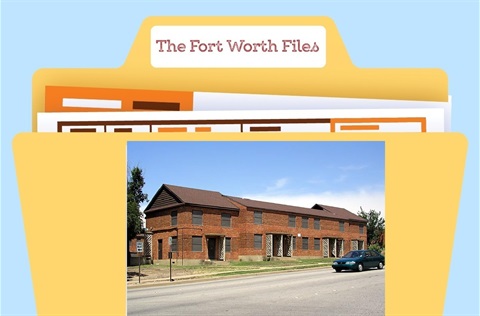
A big part of Fort Worth’s World War II-era public housing buildings met the wrecking ball in 2003.
The Ripley Arnold housing project was a federally subsidized apartment complex in downtown Fort Worth, located along the Trinity River at Belknap and Henderson streets.
The community opened in 1940 as one of the Public Works Administration’s 52 public housing projects built nationwide in response to the Great Depression. During that period, Fort Worth’s population growth outpaced new housing development while many residential areas deteriorated. In 1940 it was reported that 7,400 families lived in “blighted areas” that lacked running water, ventilation and sanitation.
In 1938 a $2.2 million contract between the U.S. Housing Authority and the newly established Fort Worth Housing Authority (FWHA) was signed to fund a 252-unit low-income housing project for white families and a 250-unit project for Black families. The former became the Ripley Arnold housing project, and the Black housing became the Butler Place housing project.
Ripley Arnold and Butler Place were designed using modernist principles that emphasized “form and function.” The results were red brick apartments in a “stripped or minimalist adaptation of the Colonial Revival style” that was popular in early 20-century architecture.
Rent: $17.25 a month
The first families moved into units in September 1940.
Individual units contained three to five-and-a-half rooms, with rents ranging from $17.25 to $18.50 per month, slightly more expensive than those at Butler Place. To qualify, families were required to have a net income of less than five to six times the rent amount, depending on the family’s number of dependents.
After its first year, Ripley Arnold housed 853 residents, while more than 500 remained on the waitlist. By that time, the community had a prenatal clinic, a preschool center, Boy Scouts and Camp Fire Girls clubs and even a newspaper, the Ripley Arnold Citizen.
In the early 1940s, in anticipation of increased housing demands following the completion of the Consolidated Vultee Aircraft Corp. plant near Lake Worth, FWHA sought to build a 72-unit expansion at the Ripley Arnold site and a new housing project near the plant. The new project became Liberator Village, but the Ripley Arnold expansion, despite federal approval, never got off the ground.
Video: Take a look at public housing in Fort Worth in the early 1970s, courtesy of KERA and the SMU Jones Film Library.
Downtown leaders decry “eyesore”
Although segregated housing was prohibited by the Fair Housing Act of 1968, a 1984 report showed that most of Tarrant County’s public housing projects were either overwhelmingly white or overwhelmingly Black. Ripley Arnold was substantially desegregated. Its demographics were 41% Black, 41% white and 18% Hispanic.
In 1980 Ripley Arnold underwent federally funded renovations to provide updated heating systems and insulation, install new bathroom and kitchen appliances and lay tiles to replace concrete floors, among other improvements.
Despite the modifications, the complex was still considered an eyesore by many. And Ripley Arnold became a hotspot for violent crime, gang activity and drug abuse, which spurred pleas for heightened security and improved conditions.
The end of an era
Advancing plans for the redevelopment and sale of the Ripley Arnold property proved difficult. In 1982 plans to acquire two blocks of the property were announced as part of a plan to build new county courts buildings downtown. However, officials were forced to consider alternate locations after issues relating to the relocation of residents, and the need for federal approval stymied the process.
FWHA eventually decided that, with approval from the U.S. Department of Housing and Urban Development, the Ripley Arnold complex would be sold to finance planned renovations of Butler Place and a high-rise complex, Hunter Plaza.
In 2001, Fort Worth-based RadioShack Corp. agreed to purchase the 24-acre Ripley Arnold property for $20 million to build its new corporate headquarters. Many of Ripley Arnold’s 521 residents, arguing that they had been given no assurances that they would be moved into quality housing and that they wanted the downtown housing modernized rather than be relocated, quickly moved to block the sale. Romona Utti, president of the Ripley Arnold Residents Association, led the community’s advocacy efforts.
Claims of the historic significance of the housing units also complicated the sale. After much debate, the FWHA, HUD and the Texas Historical Commission reached an agreement allowing the property to be sold. Conditions included requiring that FWHA develop mixed-income housing units; that residents be given cash, legal assistance and computers as part of the relocation process; that some residents be relocated to refurbished historic buildings or historic neighborhoods throughout Fort Worth; that the Ripley Arnold site be memorialized with a waterfront plaza; and that historic photos and documents of the housing project be donated to the Fort Worth Public Library.
In 2002 residents began moving out of Ripley Arnold. That same year, FWHA made plans to build Overton Park Townhomes, a 216-unit apartment complex in the Cityview area of southwest Fort Worth. Sixty-five units were set aside for displaced Ripley Arnold residents. The housing authority also purchased the Stonegate Villas complex near Colonial Country Club with plans to set aside 20% of units for low-income residents.
The decision drew the ire of local residents and sparked weeks of protest, public debate and political scrutiny of City officials as Hulen-area residents complained that the sale would bring crime and lower property values in their neighborhood.
Despite the pushback, the deal was finalized, and 58 units were reserved for former Ripley Arnold occupants.
The Ripley Arnold community closed in October 2002 after 62 years of operation. The complex was demolished in 2003.
In 2008 the Tarrant County College District bought the RadioShack campus at the former Ripley Arnold site for use as its Trinity River Campus.
Photo: Ripley Arnold, formerly located on the north end of downtown at Belknap and Henderson streets, was built in a minimalist version of Colonial Revival style.
Photo: A Heritage Trails historical marker at 489 N. Taylor St. honors the housing community.
Photo:The Ripley Arnold community closed in October 2002 after 62 years of operation and was demolished in 2003.
Photo: R. Leland Hunter, executive director of the Fort Worth Housing Authority, inspects a newly completed project built especially for low-income elderly people. At the right is a community center building, with one of the efficiency apartment buildings at the left. The two-story building in the background is part of the Ripley Arnold Place housing project. This photo appeared in the Fort Worth Star-Telegram morning edition of June 2, 1962. (Photo courtesy of University of Texas at Arlington Libraries, Special Collections.)
Who was Ripley Arnold?
Major Ripley Arnold (1817-1853) was a U.S. Army officer best known as the founder of Fort Worth.
On June 6, 1849, under military orders, he established a frontier military post on the Trinity River called Camp Worth. Later that year, the post was designated as Fort Worth, which served to protect nearby settlers and eventually grew into the modern city we know today.
In 1853 Arnold returned to command Fort Graham in Hill County, Texas. On Sept. 6, 1853, at just 36 years old, he was shot and killed during a confrontation with the post’s assistant surgeon.
Though initially buried at Fort Graham, Arnold’s body was later moved to Pioneers Rest Cemetery in Fort Worth, where he rests alongside two of his children. His legacy is honored with a large bronze statue at the Panther Island Pavilion plaza along the Trinity River.
Get articles like this in your inbox. Subscribe to City News.